Opening night saw the Royal Opera House buzzing for a new production of Handel’s Alcina, As if Alcina’s magic perfume cast a sleeping spell on the once-eager audience. Director Richard Jones’ production is a deconstructed Alcina — it takes apart the pieces of Handel’s hit, but is unable to put them back together.
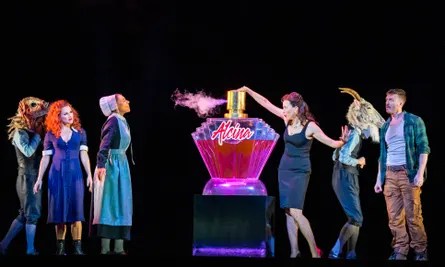
The stage is a black box. It’s a set for rehearsal more than a main stage (Even the opera house’s signature red, velvet royal curtains have been lifted into the eaves.)
Intellectually, it works. Alcina is a show of constructed reality. With each spell, the chorus wheels out a new set piece on storage trolleys — forests, rocks, and greenhouses — that pepper the stage, but fail to fill it.
For a story that could be an immersive fantasy, it’s instead a backstage storeroom. And maybe that’s the point—Alcina’s world is fake and we are meant to stay on the outside. It’s an aesthetic that can be anything or nothing. Unfortunately, it chooses to be nothing.
The thing about Handel — he wrote at a time when music written in England was expected to be religious. Handel pushed the boundaries of theatre, famously preferring the then-seedier world of Covent Garden. He brought sex and scandal to his operas. His operas are risqué and sexy, but with enough religious overtones to allow plausible deniability. This also makes Handel’s operas liable to be sanitised and presented as moral lessons.
Unfortunately what could be a sexy and exciting Alcina, is muted by its pervasive Puritan aesthetic. Scenes of pleasure and sex-positivity are squashed by an imposing moralism its Puritan characters demand. In the final scene, Alcina reveals a sign to herald “the joy of sex.” This is unconvincing—Puritanism has won the evening.
But let’s go back to the fun parts, shall we.
The voices and the orchestra were superb.
If you come to the Royal Opera House for world class singing, expect intoxicating performances from Lisette Oropesa as Alcina and Mary Bevan as Morgana. As the sister witches, their voices are as beautiful and as authoritative as their characters themselves. Rupert Charlesworth as Oronte is a standout for his vibrato-rich tenor and convincing acting.
Lisette Oropesa’s Alcina charms the evening. Oropesa has an exquisitely clear and strong voice that is agile and crisp on Handle’s signature step-wise runs. She’s a joy to listen to.
Christian Curnyn conducts a well-balanced and measured orchestra. This is a well-behaved Handel. It’s a joy to hear instruments familiar to Handel’s time, but less familiar to modern orchestras. The harpsichord, lutes, and recorders add a satisfying texture to the orchestra pit. The solos from the first cellist are particularly melodic and deserve every moment of their standing ovation.
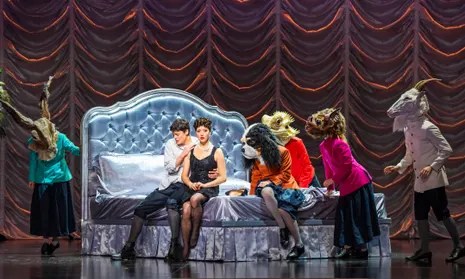
There are flashes of brilliance. Jones’ Alcina is at its best with its dancing animals. Transformed from Puritans into animals, the chorus becomes a zoo of giant, animal puppet heads atop brightly coloured Puritan garb. It’s absurd; it’s slightly sexual; and it’s delicious. Morgana’s aria at the end of Act 1 is particularly entertaining.
Fortunately for us, the dancing animals return to fill the empty stage throughout all three acts. Dogs, lizards, lions, parrots, eagles, and animals both domestic and exotic prance on stage. Sarah Fahie’s choreography is a welcome addition to the otherwise plain staging.
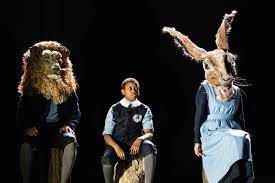
Unfortunately, powerful as she is, Alcina’s magic couldn’t dispel the evening’s hecklers. Let me take a moment to say — Malakai M Bayoh was a joy as Oberto, the boy searching for his father. His performance, carrying “Missing” posters across stage and into the audience through the interval, and his ability to stay on stage and perform through inappropriate heckling deserves praise. Bayoh has a bright future ahead.
Jones’ Alcina might not have as bright of a future. Though it appears it will keep the lights on a few nights longer.
It’s a pleasant Alcina that’s worth keeping your ticket, if you have one, and waiting for the Glyndebourne encore if you have yet to decide.
Alcina is on the Royal Opera House Main Stage until 26 November 2022. For ticket information click here.
 London Show Cap
Leave a comment